
Disclosure: AskGyd may earn a commission if you buy through links on this page, at no extra cost to you. Recommendations below include labeled placeholders until specific merchant links are added. We do not claim to have lab-tested the products discussed. Read the full disclosure.
A stroller is less a status object than a piece of daily logistics equipment. It has to fold into the space you actually have, roll over the surfaces you actually walk, and carry the things a small child accumulates in an afternoon. If you shop only from lifestyle photos, it is easy to bring home a frame that is handsome in a store aisle and exhausting on a cracked sidewalk or a third-floor walk-up.
This guide walks through types, weight, wheels, fold, storage, recline, and safety questions to ask. It does not rank models, invent test scores, or claim that we put a fleet of strollers through a lab course. Use it to build a shortlist that matches your terrain and routine, then confirm current specifications and any recalls with the manufacturer and official safety sources before you buy.
First, pick a type that matches your day
Full-size or everyday strollers usually offer a more comfortable seat, a larger canopy, and a bigger basket. They can be excellent if you walk a lot and have room to store a larger fold. They are less ideal if you rely on tight car trunks, buses, or narrow apartment hallways.
Compact or “travel” strollers emphasize a smaller fold and lower weight. The tradeoff is often a firmer ride, a smaller basket, and a less generous seat. These make sense if you climb stairs, travel, or already have a fuller stroller at home and need a second, grab-and-go frame. “Travel stroller” on a product page does not automatically mean it is approved as a carry-on or that it will fit in every overhead bin; check current airline and cabin rules separately.
Jogging or all-terrain strollers typically have larger wheels and more suspension. They can be the right tool for rough paths or running, with important caveats: not every child is ready to be in a jogging stroller, and not every model is meant for running. Read the manufacturer’s age, weight, and use limits. A three-wheel shape alone does not make a stroller safe to jog with.
Double strollers come in side-by-side and tandem (one seat ahead of the other) layouts. Side-by-side frames can be too wide for some doors and sidewalks. Tandems can be longer and harder to turn in small elevators. If you need two seats only for a short season, a sit-and-stand or a rider board — where available and used according to the manual — can be a less bulky alternative, with their own weight limits.
Weight versus stability is a real tradeoff
Every pound matters when you lift a stroller into a trunk or carry it up a stoop, especially with a child in one arm. Lighter frames are easier to lift and often easier to fold with one hand. They can also feel more twitchy with a heavier toddler, a loaded basket, or a strong crosswind. Heavier strollers can track more calmly and absorb broken pavement better. Neither is universally “better.” Write down the heaviest lift you will do in a normal week and be honest about it.
The published frame weight often excludes the canopy, a fully loaded basket, a cup holder, or an attached infant seat. Compare like with like, and add the cargo you actually carry — groceries, a diaper bag, a water bottle — when you imagine pushing it one-handed up a curb.
Wheels, swivel, and terrain
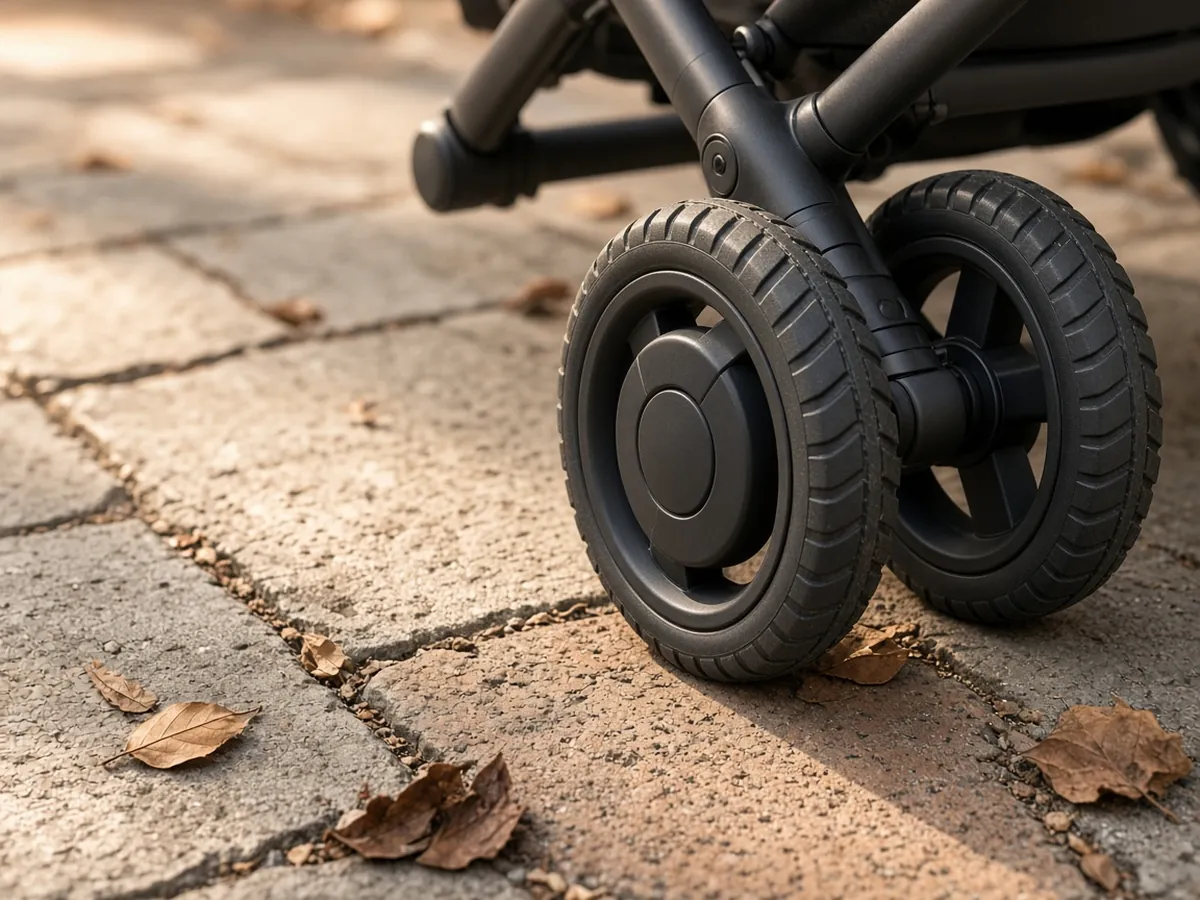
Small, hard wheels roll well in a smooth mall and poorly on gravel, brick, or unshoveled sidewalks. Larger wheels and a bit of suspension generally make uneven ground less punishing, at the cost of bulk. Front wheels that swivel help you turn in a café; wheels that lock forward can feel more stable at speed or on rough paths. If your neighborhood includes both, a lockable swivel is more useful than a marketing word like “all-terrain” with tiny wheels.
Think about curbs, elevator gaps, grass parks, and winter slush. If you regularly cross cobblestones or dirt paths, prioritize wheel size and a brake you can use confidently with the shoes you actually wear. Check how the brake is engaged (a rear bar you step on versus a hand lever) and whether you can reach it while holding the handlebar.
The fold is part of the product
A “one-handed fold” is only useful if it is a fold you can repeat with a child on your hip, not just in a quiet showroom. Look for a fold that stands on its own if you will store it in a hallway, and for a fold that stays folded when you lift it. Measure your trunk opening and the closet or gap beside a fridge. Dimensions in a listing sometimes describe the folded package without accounting for wheels that stick out or a handle that does not telescope in.
If you will move the stroller in and out of a car several times a day, practice the motion in your head: unzip the trunk, fold, lift, close, walk around with a child. A slightly heavier stroller with a reliable, compact fold can be easier in real life than an ultralight frame that sprawls when folded or requires two hands and a wrestling match.
Basket, handle, and the rest of the day
Basket capacity is not a vanity number. If you shop on foot, a shallow, hard-to-reach basket will train you to hang bags on the handlebar, which can make a stroller tip. Look for a basket you can access with the seat reclined, if that is how naps happen in your life. Handle height matters if caregivers are very different heights; an adjustable handle is worth seeking in that case. Wrist straps, a parking brake that is obvious, and a canopy that actually blocks late-afternoon sun are ordinary features that change a walk more than a new colorway.
Seat, harness, recline, and newborn use
A seat that reclines nearly flat is important if the stroller will be used for naps or for a younger infant, but only when the manufacturer says that use is appropriate. Many seats are not suitable from birth without a bassinet or a compatible infant capsule, and some reclines still leave a child in a position that is not right for a newborn. Follow the manual, not a photo of a sleeping baby on a product page.
A five-point harness should be adjustable as a child grows, with straps that stay on the shoulders. Canopies with a peek-a-boo window are convenient; mesh vents help on hot days. If you live in strong sun or harsh winter wind, look at how complete the coverage is rather than at whether the canopy has a pattern you like.
“Travel system” compatibility, without the brand puzzle
Some strollers accept an infant car seat with adapters. That can be genuinely useful for short transfers from car to café in the early months. It is also a feature you may use for a short season. Confirm, from the current manufacturer documentation, exactly which seats fit which adapters — compatibility lists change. Do not assume that two products sold in the same store click together. And remember that a car seat on a stroller frame is for transport, used according to the infant seat’s instructions; it is not automatically an all-day napping place.
Safety questions to ask, and where to check
In the United States, strollers are consumer products with safety expectations that have changed over time (including issues historically associated with hinges, stability, and entrapment). Look for products that the manufacturer states meet current applicable U.S. safety standards, and take a moment to search official recall information, such as notices from the U.S. Consumer Product Safety Commission, for the specific model name before you buy, especially if you are shopping secondhand.
Do not use a stroller that is damaged, missing a safety label, or recalled. Follow weight and age limits, use the harness every time, do not hang heavy bags on the handle, and never leave a child unattended. This guide is not a substitute for the product manual or for professional advice about a child’s specific medical needs (for example, positioning needs that require specialist equipment).
Spending, secondhand, and extras
Price in this category often pays for a smoother fold, better wheels, a more durable fabric, or a brand’s accessory ecosystem — not automatically for a safer seat. There is no honest single number at which strollers become “good.” Decide which two or three features you cannot compromise on (for many families: a compact fold, a usable basket, and wheels that match the sidewalk), and treat the rest as optional.
Secondhand frames can be practical, but inspect the hinge locks, brake, harness, and wheel wear, and check recalls. Skip a used stroller if the history is unclear or parts are missing. Extras such as organizers, snack trays, and weather shields are useful only if they fit your model and do not interfere with the fold or the harness.
Product slots (affiliate placeholders)
These cards describe types of stroller, not tested winners. Links are placeholders until a merchant URL is added.
A compact everyday stroller
Look for a self-standing fold, a stated folded size that would fit your trunk, and a basket you can reach when the seat is reclined. Confirm infant suitability in the current manual.
View productA fuller-size walking stroller
Consider this pattern if you walk long distances on mixed sidewalks and have storage space. Prioritize wheel size, a deep basket, and an adjustable handle if caregivers differ in height.
View productAn all-terrain or jogging-capable frame
Only if the manufacturer explicitly supports the activity you have in mind, and only within posted age and weight limits. Larger wheels should come with a brake you can use confidently.
View productWhat to remember
Choose a stroller for your stairs, sidewalks, and trunk, not for a showroom photo. Weight, wheels, fold, and basket access decide whether you will actually use it. Confirm infant suitability, compatibility, and recalls from primary sources before you pay.
Common questions
Is a heavier stroller always safer?
No. Mass can make a frame feel planted, but safety depends on sound design, intact locks and brakes, correct use of the harness, and staying within weight limits. A heavy stroller that is hard to lift can also create risky situations on stairs or in parking lots.
Do I need a travel system?
Only if you will regularly move a sleeping infant from car to stroller in the early months and the specific seat and adapters are documented as compatible. Many families do well with a stroller that is suitable from birth in its own seat or bassinet, or with a carrier for short trips, instead of buying a system they barely use.
Can I take any compact stroller on a plane?
Not automatically. Airline rules for gate-checking or cabin storage change and differ by carrier and aircraft. Check the airline’s current policy and the stroller’s folded dimensions; do not rely on the phrase “travel stroller” alone.
Related: More in Baby & Kids